The Wind Through the Keyhole was published in 2012, eight years after the Dark Tower series ended, but its story takes place between Wizard and Glass and Wolves of the Calla. King himself suggested reading it in that position, so it appears there in the list above.
Where Should You Start With Stephen King?
The best first King book depends on what kind of story you want, since his work ranges far beyond horror. Pick the line that matches your mood and start with the first title listed.
For classic supernatural horror, start with The Shining, then Pet Sematary or 'Salem's Lot. These are the books that built King's reputation, and they show how he grounds terror in ordinary family life.
For suspense without anything supernatural, start with Misery, then Gerald's Game or Billy Summers. The tension comes entirely from people, which makes them a good fit for thriller readers.
For a detective story, start with Mr. Mercedes. It opens the Bill Hodges and Holly Gibney series, King's longest-running set of crime novels.
For history, time travel, or science fiction, start with 11/22/63, then The Institute or The Stand. These show King's range as a storyteller more than his skill at scares.
For epic fantasy, start with The Gunslinger or Fairy Tale. The Gunslinger opens The Dark Tower, while Fairy Tale is a standalone quest that works well for readers who want one complete story.
For something short, start with Carrie, Joyland, or Later. Each runs well under 400 pages and gives a clear sense of King's voice without a large time commitment.
Carrie remains the most common recommendation for brand-new readers because it is King's first novel, it is short, and it introduces nearly every theme he returns to over the next five decades.
Connected Reading Paths Across the King Universe
Beyond the official series, many King books are linked through shared places and characters. None of these paths is required, but following one turns a long bibliography into a single, larger story.
The Extended Dark Tower Path
The Dark Tower sits at the center of King's fiction, and several standalone novels feed directly into it. This order keeps the core series intact while placing the most important tie-ins just before the books that depend on them. Reading The Stand at any point before this path also helps, because its villain, Randall Flagg, returns as a major figure in the series.
The Gunslinger
The Drawing of the Three
The Waste Lands
Wizard and Glass
The Wind Through the Keyhole
Insomnia, which introduces the Crimson King
Hearts in Atlantis, for the novella Low Men in Yellow Coats and the character Ted Brautigan
'Salem's Lot, which introduces Father Callahan
Wolves of the Calla
Song of Susannah
The Talisman and Black House, which bring Ted Brautigan's fellow Breakers and the Crimson King's plans into focus
The Dark Tower
Other Worlds Than These, the 2026 conclusion of the Talisman trilogy, is best read after the full Dark Tower series, since its title echoes a well-known line from the series and it continues the Talisman books' links to that world.
Castle Rock Books
Castle Rock, Maine, is King's most frequently used fictional town. The Dead Zone introduced it, and Cujo, The Dark Half, and Needful Things built it out, with Needful Things written as a farewell to the town. The novella The Body, from Different Seasons, is also set there, as are the Gwendy books and the short novel Elevation. Reading them in publication order lets you watch the town and its sheriffs change over decades.
Derry Books
Derry, Maine, is the home of It, and King returns to it in Insomnia and Dreamcatcher. 11/22/63 includes an extended visit to Derry in 1958 in which the narrator meets two of the children from It. Reading It first makes those later scenes land much harder.
The Richard Bachman Books
Between 1977 and 1984, King published several novels under the pen name Richard Bachman, partly to test whether his success came from talent or from his name. The pseudonym was exposed in 1985, but King returned to it twice more. The Bachman books do not need a reading order, though they share a bleaker, more stripped-down tone than most of his work.
The Bachman novels are Rage (1977), The Long Walk (1979), Roadwork (1981), The Running Man (1982), Thinner (1984), The Regulators (1996), and Blaze (2007). The Regulators was published alongside Desperation, a King novel that shares many of its character names in a completely different story, so the two make an unusual pair to read back to back.
Rage is the one Bachman book you will not find in current printings. King asked his publisher to withdraw it after the novel was linked to several real school shootings, and he has written that he is glad it is no longer available. It remains out of print, which is why most modern lists of his work leave it out.
Every Stephen King Book by Decade
This is King's fiction in publication order, with novels and story collections listed separately so you can see at a glance what is a full-length book. Bachman titles and co-written books are included.
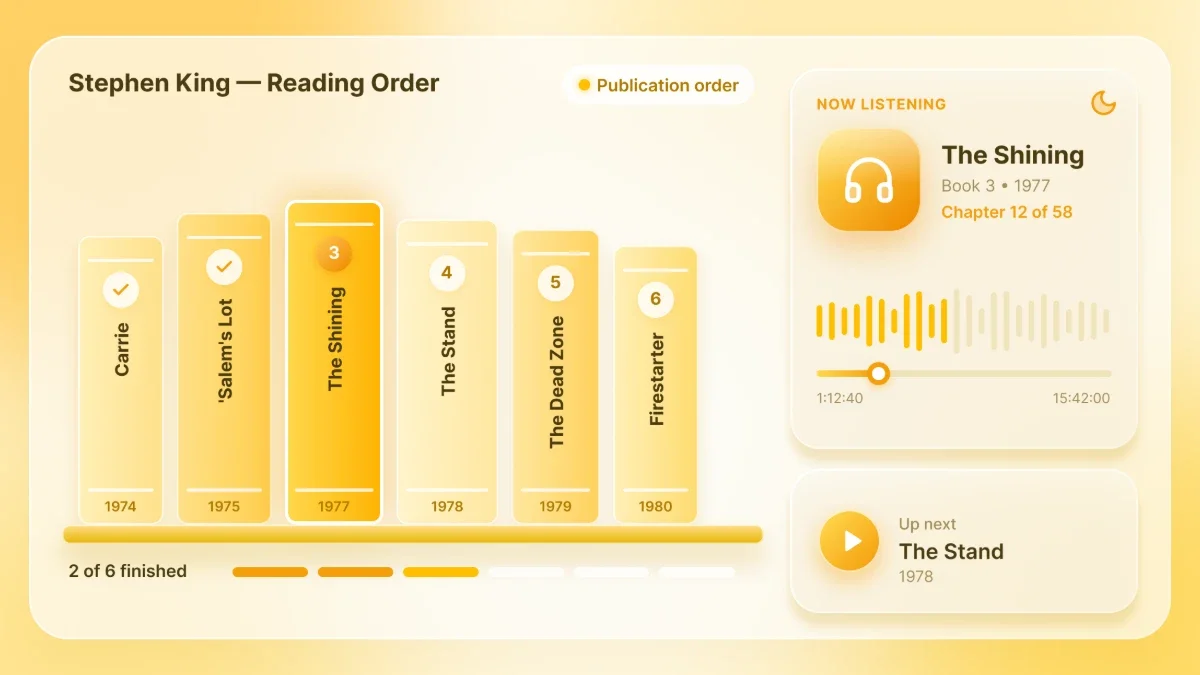
1970s. Novels: Carrie (1974), 'Salem's Lot (1975), The Shining (1977), Rage (1977), The Stand (1978), The Dead Zone (1979), The Long Walk (1979). Collection: Night Shift (1978).
1980s. Novels: Firestarter (1980), Cujo (1981), Roadwork (1981), The Running Man (1982), The Gunslinger (1982), Christine (1983), Pet Sematary (1983), The Talisman (1984), Thinner (1984), The Eyes of the Dragon (1984), It (1986), The Drawing of the Three (1987), Misery (1987), The Tommyknockers (1987), The Dark Half (1989). Novella: Cycle of the Werewolf (1983). Collections: Different Seasons (1982), Skeleton Crew (1985).
1990s. Novels: The Waste Lands (1991), Needful Things (1991), Gerald's Game (1992), Dolores Claiborne (1993), Insomnia (1994), Rose Madder (1995), The Green Mile (1996), Desperation (1996), The Regulators (1996), Wizard and Glass (1997), Bag of Bones (1998), The Girl Who Loved Tom Gordon (1999). Collections: Four Past Midnight (1990), Nightmares and Dreamscapes (1993), Hearts in Atlantis (1999).
2000s. Novels: Dreamcatcher (2001), Black House (2001), From a Buick 8 (2002), Wolves of the Calla (2003), Song of Susannah (2004), The Dark Tower (2004), The Colorado Kid (2005), Cell (2006), Lisey's Story (2006), Blaze (2007), Duma Key (2008), Under the Dome (2009). Collections: Everything's Eventual (2002), Just After Sunset (2008).
2010s. Novels: 11/22/63 (2011), The Wind Through the Keyhole (2012), Joyland (2013), Doctor Sleep (2013), Mr. Mercedes (2014), Revival (2014), Finders Keepers (2015), End of Watch (2016), Sleeping Beauties (2017, with Owen King), The Outsider (2018), The Institute (2019). Novellas: Gwendy's Button Box (2017, with Richard Chizmar), Elevation (2018). Collections: Full Dark, No Stars (2010), The Bazaar of Bad Dreams (2015).
2020s. Novels: Later (2021), Billy Summers (2021), Fairy Tale (2022), Gwendy's Final Task (2022, with Richard Chizmar), Holly (2023), Never Flinch (2025), Other Worlds Than These (2026, with Peter Straub). Collections: If It Bleeds (2020), You Like It Darker (2024).
King has also written two well-known nonfiction books, Danse Macabre (1981) and On Writing (2000). On Writing in particular is often recommended to readers who want to understand how he works before diving into the novels.
Newest Stephen King Books and Recent Adaptations
The newest Stephen King book is Other Worlds Than These, published on October 6, 2026. It completes the Talisman trilogy and follows Jack Sawyer one last time. Peter Straub died in 2022, so King wrote the book on his own while building on story ideas the two had developed together, and Straub shares the author credit. Before it came Never Flinch (2025), the latest Holly Gibney novel, and the story collection You Like It Darker (2024).
Adaptations are one of the main reasons readers come back to King's books, and 2025 was an unusually busy year with six of them. The Monkey adapted a short story from Skeleton Crew, and The Life of Chuck, directed by Mike Flanagan, adapted a novella from If It Bleeds. The Long Walk and The Running Man both brought Bachman novels to theaters, while Welcome to Derry, a prequel series to It, and a series based on The Institute arrived on television.
More are on the way. A new Carrie limited series from Mike Flanagan has been reported for October 2026, and Flanagan is also developing The Dark Tower for television. A series based on Fairy Tale is in development as well. If you plan to watch any of these, reading the book first is the best way to see how much of King's interior voice, the part that rarely survives the move to the screen, shapes the story.
Reading and Listening Your Way Through the King Bibliography
The simplest approach is to read the series in order, treat everything else as a menu, and follow a connected path like Castle Rock or The Dark Tower whenever a book leaves you wanting more of its world. Few readers finish all of King's work, and most never need to: the pleasure is in following the threads that interest you.
A bibliography this size is a real time commitment. The Dark Tower alone runs eight books, and It and The Stand each pass 1,000 pages in most editions. Listening is one of the easiest ways to keep pace: Listen AI turns PDFs, articles, and documents into natural-sounding audio, so you can move through a long King novel, a reading-order guide like this one, or background on the next book while you commute, cook, or exercise, then pick the printed page back up whenever you like.