1. Looney Tunes (1930)
Mel Blanc defined the sound of Looney Tunes for nearly five decades. He originated Bugs Bunny, Daffy Duck, Porky Pig, Tweety, Sylvester, and Yosemite Sam, and gave each one a completely different rhythm and vocal placement. Bugs got an unhurried, wisecracking drawl built around "What's up, Doc?", while Daffy got a sputtering lisp and Porky a gentle stammer.
Blanc was known as "The Man of a Thousand Voices," and he was one of the first voice actors to earn regular on-screen credit. After his death in 1989, performers such as Jeff Bergman, Joe Alaskey, and Bob Bergen carried the characters forward. Today Eric Bauza voices Bugs, Daffy, and several of their co-stars. Every actor who has played Bugs Bunny since 1989 has been measured against Mel Blanc's original performance.
2. Scooby-Doo (1969)
Scooby-Doo, Where Are You! premiered in 1969 with Don Messick as Scooby and Casey Kasem as Shaggy. Messick built Scooby's half-growled speech and his famous "Ruh-roh" out of a dog's natural sounds. Kasem gave Shaggy a cracking, nervous voice and stayed with the role for most of four decades.
Frank Welker voiced Fred Jones in the 1969 original and has stayed with the franchise ever since. In 2002 he also took over Scooby himself, so one performer now voices both the leader of the gang and its dog. Frank Welker has been part of the Scooby-Doo cast for more than 55 years, longer than any other performer. Matthew Lillard took over Shaggy in 2010 after playing the character in live-action films, and Grey DeLisle has voiced Daphne since the early 2000s.
3. Transformers (1984)
The original animated Transformers series arrived in 1984, and Peter Cullen's Optimus Prime became its emotional center. Cullen has said he based the character's calm, steady authority partly on his older brother, a Marine. He returned to the role for the live-action films beginning in 2007, which is why many fans have heard the same Optimus for four decades.
Frank Welker voiced Megatron in the same series, layering arrogance and menace under a raspy, processed tone. Chris Latta gave Starscream his shrill, scheming whine, the opposite of Megatron's cold control. Because so many Transformers share similar robotic designs, the voice cast did much of the work of telling the characters apart.
4. The Simpsons (1989)
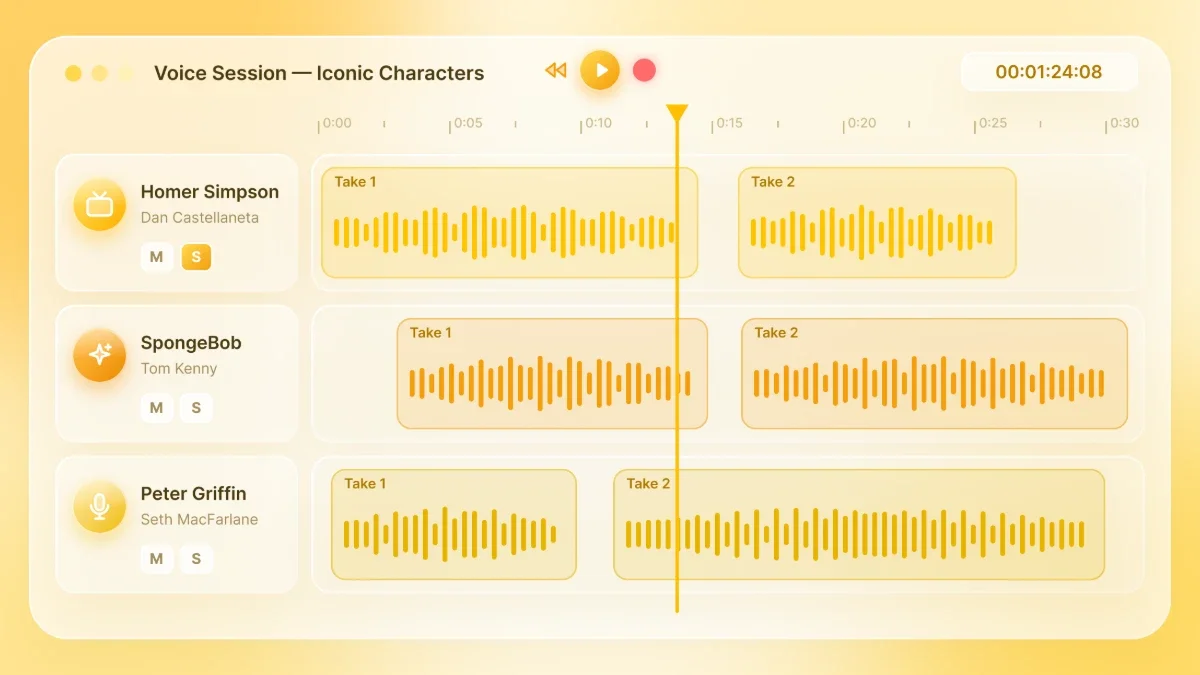
The Simpson family first appeared in short segments in 1987 and became a half-hour series in 1989. Dan Castellaneta voices Homer, along with Grampa, Krusty, and Barney. Julie Kavner voices Marge and her sisters Patty and Selma, and Yeardley Smith has voiced Lisa from the start.
Nancy Cartwright originally auditioned for Lisa but asked to read for Bart instead, and the role has been hers ever since. She also voices Nelson, Ralph Wiggum, and Todd Flanders. Hank Azaria and Harry Shearer fill out much of Springfield, with Azaria voicing Moe and Chief Wiggum and Shearer voicing Mr. Burns, Smithers, Ned Flanders, and Principal Skinner. The Simpsons has kept nearly its entire main voice cast since 1989, a level of continuity almost unheard of in television.
5. Rugrats (1991)
Rugrats told its stories from a baby's point of view, so its voice cast had to make toddlers sound both funny and believable. E.G. Daily voices Tommy Pickles with a raspy, fearless bravado. Cheryl Chase voices Angelica Pickles, the bossy older cousin whose sweet voice for adults and sharp voice for babies became the show's best running joke.
Christine Cavanaugh originated Chuckie Finster from 1991 to 2001, giving him his trembling, worried delivery. Nancy Cartwright took over the role in 2002 and has kept it in every version since. Kath Soucie voices the twins Phil and Lil as well as their mother, Betty DeVille, so three members of one family share a single performer. Tress MacNeille rounds out the adults as Tommy's mother, Charlotte Pickles.
6. The Powerpuff Girls (1998)
The Powerpuff Girls needed three heroines who sounded related but never interchangeable. Cathy Cavadini voices Blossom, the composed leader. Tara Strong gives Bubbles an airy, sweet quality, and E.G. Daily, the voice of Tommy Pickles, gives Buttercup a tough, scrappy edge.
The supporting cast is just as memorable. Roger L. Jackson voices the villain Mojo Jojo with his over-explained, repetitive speeches. Tom Kenny voices both the scattered Mayor of Townsville and the show's narrator. Tom Kane voices the gentle Professor Utonium and the unsettling villain HIM, two roles that could hardly be further apart. A 2016 reboot recast the three girls with new performers.
7. SpongeBob SquarePants (1999)
Tom Kenny has voiced SpongeBob since the show premiered in 1999, built on a bright, eager tone and a laugh fans recognize instantly. He also voices SpongeBob's pet snail Gary and the French-accented narrator. The rest of Bikini Bottom has been remarkably stable: Bill Fagerbakke voices Patrick, Rodger Bumpass voices Squidward, Clancy Brown voices Mr. Krabs, Carolyn Lawrence voices Sandy, and Mr. Lawrence voices Plankton.
Clancy Brown is also a well-known live-action character actor, a reminder that many voice performers split their careers between on-screen and voice-only roles. The core SpongeBob cast has stayed largely unchanged for more than 25 years, which helps explain why the show still sounds the way it did in 1999.
8. Futurama (1999)
Billy West carries an unusual share of Futurama on his own. He voices Fry, Professor Farnsworth, Dr. Zoidberg, and Zapp Brannigan, each with a completely different physical rhythm to their speech. Katey Sagal voices Leela, and John DiMaggio voices Bender with a gruff, sarcastic swagger.
Phil LaMarr voices Hermes Conrad with clipped, bureaucratic precision, while Maurice LaMarche voices Kif, Calculon, and Morbo. Lauren Tom voices Amy, and Tress MacNeille plays the scheming executive Mom. When the show was revived in 2023, DiMaggio initially was not part of the announced cast over a contract dispute. He returned before production, and the original cast came back intact.
9. Star Wars: The Clone Wars (2008)
Star Wars: The Clone Wars began with a 2008 animated film and series. Matt Lanter voices Anakin Skywalker, James Arnold Taylor voices Obi-Wan Kenobi, and Ashley Eckstein voices Ahsoka Tano, the apprentice who became one of the franchise's most popular characters.
Dee Bradley Baker voiced nearly every clone trooper in the series, including Captain Rex. He gave hundreds of soldiers who share the same face distinct personalities through small changes in tone and attitude. Tom Kane voiced Yoda and the newsreel-style narrator who opened each episode. Kane suffered a stroke in November 2020 and announced his retirement in 2021. He died in May 2026 at age 64, leaving a body of work that stretched from The Powerpuff Girls to Star Wars.
10. Adventure Time (2010)
Jeremy Shada voices Finn the Human, a role he started as a young teenager. As Shada's voice deepened over the series, the show let Finn's voice change with it, so the character audibly grows up on screen. John DiMaggio voices Jake the Dog with a relaxed, easygoing energy that plays against Finn's enthusiasm.
Tom Kenny voices the Ice King, a weary, muttering character far from SpongeBob's cheerfulness. Hynden Walch voices Princess Bubblegum, Olivia Olson voices Marceline, and Niki Yang voices BMO. Adventure Time shows how much a voice cast can shape a fantasy world, since its tone shifts from silly to melancholy largely through performance.
One Voice, Many Characters: The Performers Who Cross Shows
A handful of performers appear in several of the shows above, often in roles with nothing in common. Following their careers is one of the best ways to hear how much range a single voice actor can have.
Tom Kenny voices the endlessly cheerful SpongeBob, the gloomy Ice King in Adventure Time, and both the Mayor and the narrator in The Powerpuff Girls.
Frank Welker voices Fred and Scooby in Scooby-Doo and the menacing Megatron in Transformers, moving between a friendly human voice, a dog, and a machine.
John DiMaggio voices the cynical robot Bender in Futurama and the warm, laid-back Jake the Dog in Adventure Time.
Nancy Cartwright voices the mischievous Bart Simpson and the timid Chuckie Finster in Rugrats, two boys with opposite temperaments.
E.G. Daily voices the brave toddler Tommy Pickles in Rugrats and the tough-talking Buttercup in The Powerpuff Girls.
Tom Kane voiced the kindly Professor Utonium and the sinister HIM in The Powerpuff Girls, then Yoda in Star Wars: The Clone Wars.
Tress MacNeille voices Charlotte Pickles in Rugrats and the ruthless Mom in Futurama, along with many supporting characters in The Simpsons.
Phil LaMarr voices Hermes in Futurama and several Jedi and senators in Star Wars: The Clone Wars.
Recent Revivals, Movies, and New Seasons
Most of these shows are still active in some form, and several have brought their original voice casts back for new projects.
The Simpsons premiered its 38th season in September 2026 and is renewed through Season 40, expected in the 2028 to 2029 TV season. Nancy Cartwright has said she personally expects the show to end with Season 40, though no final season has been announced.
Futurama returned in 2023 after a decade off the air, with Season 13 released in September 2025 and Season 14 following in 2026. Billy West, Katey Sagal, and John DiMaggio all reprised their roles.
The SpongeBob Movie: Search for SquarePants, the franchise's fourth theatrical film, opened in December 2025 with Tom Kenny, Bill Fagerbakke, Rodger Bumpass, and Clancy Brown returning.
Rugrats returned in 2021 as a CG-animated revival, with E.G. Daily, Nancy Cartwright, Cheryl Chase, and Kath Soucie back in their original roles.
Looney Tunes reached theaters with The Day the Earth Blew Up: A Looney Tunes Movie in 2025, featuring Eric Bauza as Daffy Duck and Porky Pig.
Transformers One (2024) told an animated origin story of Optimus Prime and Megatron, casting new voices for the characters' younger selves.
Adventure Time continued with the spinoff Adventure Time: Fionna and Cake in 2023, which brought back several original cast members alongside its new leads.
Why These Performances Still Matter
The voices behind these shows prove that a character's personality lives as much in pacing, pitch, and breath as in the drawing itself. Many newer voice actors study exactly these performances, listening closely to how Mel Blanc, Tom Kenny, or Nancy Cartwright shape a line, to learn the craft for themselves.
Listening is often the best way to appreciate that kind of detail. If you are reading up on voice acting, a performer's career, or the history of animation, Listen AI can turn articles and documents into natural-sounding audio, so you can keep learning while you commute, cook, or take a break from the screen.